Types of gold: purity, karats and colours explained
"Type of gold" can mean several different things. Someone may be talking about purity when they say 916 or 18K, colour when they say white or rose gold, or even construction when they say gold plated or vermeil. Those terms describe different things, so it helps to separate them.
Gold by purity

Strict 14K is 14/24 ≈ 58.33%; 585 is a commonly associated fineness mark and means 58.5%.
999 and 999.9 gold
These are very-high-purity forms of gold. They're commonly described as 24K, although 999 and 999.9 are not precisely identical. High-purity gold is widely used for bullion and can also be used for jewellery. For the current reference value, see the 999 gold price Singapore page.
916 gold
916 contains approximately 91.6% gold and is commonly described as 22K. It is widely used for jewellery because it retains a high gold content while being harder than near-pure gold. Read more about 916 gold, or see the current 916 gold price in Singapore.
18K / 750 gold
18K gold contains 75% gold. Its fineness mark is commonly 750. The remaining alloy metals can change colour and working properties, which is why 18K jewellery can be yellow, white or rose. Read more about 18K gold.
14K / 585 gold
14K and 585 are commonly used for the same jewellery purity class, but they are not mathematically identical. Strict 14K is 14 ÷ 24 ≈ 58.33% gold, while a 585 fineness mark means 58.5% gold. Where an actual fineness mark is present, use that mark when calculating value. The higher alloy content generally makes this purity class harder than higher-purity gold.
Gold by colour
Colour tells you about the alloy. It does not, by itself, tell you the purity.
Yellow gold
Yellow gold retains the familiar warm gold colour. It can exist at several purity levels, including 24K, 22K, 18K and 14K. Read more about yellow gold.
White gold
White gold is gold alloyed to produce a paler appearance. An 18K white-gold item is still 75% gold. Its colour doesn't create a separate commodity price. Read more about white gold.
Rose gold
Rose gold uses alloy metals that create a pink or reddish tone. Again, purity depends on the karat or fineness marking, not the colour. Read more about rose gold.
Solid gold, plated gold and vermeil
These terms describe how the jewellery is constructed rather than its purity or colour.
Solid gold
"Solid gold" generally means the item is made from a gold alloy throughout rather than having only a thin gold coating. It can still be 18K, 14K, 22K or another purity.
Gold plated
Gold-plated jewellery has a thin gold coating over another material. Its total object weight cannot be entered into a solid-gold calculator as though the entire piece were gold.
Gold vermeil
Vermeil is gold applied over sterling silver. It is not solid gold. Its value comes from the silver substrate, the gold coating, workmanship and the finished product rather than a simple whole-weight gold calculation. Read more about gold vermeil.
Jewellery gold vs bullion
Jewellery and bullion can contain the same metal but are priced differently. Jewellery can include workmanship, design, stones, retailer margin and GST. Bullion pricing is usually more directly related to gold content plus a product premium.
How purity affects value
If two items weigh exactly the same, the higher-purity item contains more gold. For reference-value calculations:
weight × fineness × current pure-gold value
Use the Gold Value Calculator rather than assuming every item with the same colour has the same gold content.
Why 916 and 18K jewellery prices differ
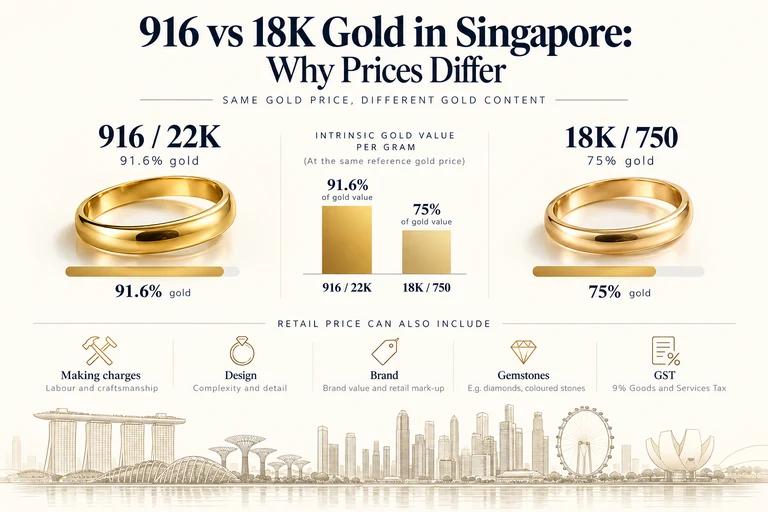
At equal weight, 916 gold contains more gold than 18K: a 916 fineness mark means 91.6% gold, while 18K/750 means 75%. This makes 916’s underlying metal-content reference value higher when the same gold price is used. But a finished 18K ring can cost more at retail because of gemstones, workmanship, design, brand and applicable tax. Purity and the total shop price are different comparisons.
| Same 10g gold-alloy weight | 916 / approximately 22K | 18K / 750 |
|---|---|---|
| Marked fineness | 0.916 | 0.750 |
| Contained fine gold | 9.16g | 7.50g |
| Underlying value method | 9.16 × reference SGD per pure-gold gram | 7.50 × reference SGD per pure-gold gram |
At the same 10g gross gold-alloy weight, 916 contains 1.66g more fine gold. Strictly, theoretical 22K is 22/24 (about 91.67%), but a stamped 916 item is calculated using 0.916. These figures describe gold content; they do not establish either item’s retail price or resale quote.
Compare the full jewellery price, not only its gold rate
Ask for net gold-alloy weight, fineness, quoted gold component, separate workmanship and design charges, stones or other materials, applicable GST and total payable. A per-gram gold component can be expressed on a pure-gold-equivalent basis by dividing that component by its fineness, provided both quotes use the same weight convention. Do not apply the comparison to the full retail ticket when it includes stones or making charges.
What changes when you sell?
The intrinsic metal reference may help explain a starting value, but a buyer’s actual offer depends on the item, verified purity, payable gold weight, condition and transaction terms. An original jewellery making charge, brand or gemstone price is not automatically recovered when selling or trading in.
Calculate gold value by purity using the Universal Gold Value Calculator. See also: what 916 gold means, understand 18K gold, the current 916 reference price in Singapore, and how Singapore gold prices are calculated.